Capitalism and Equality

Home

Footnote-[13]

Footnote-[12]

Thesis

Capitalism is an economic system which creates a huge division between the wealthy and the needy. Through the course of history, capitalism has led to multiple cases of inequality. This is not surprising, as it can be mathematically described through models such as the yard sale model.

Background

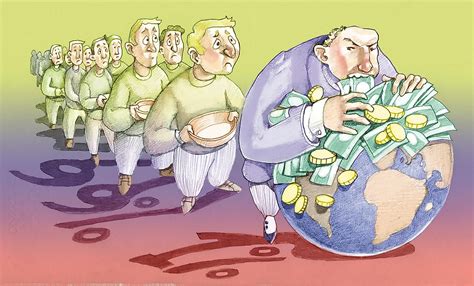
Currently, there is a massive division between people in terms of wealth. In 2018, 388 individuals roaming this planet collectively had more wealth than the poorest half of the world. The very next year, in 2019, this number further reduced to 26. This will only get worse over time, as it has been mathematically proven to be the case. So, what is causing it? Most countries today use the economic system of Capitalism. Navigate to the Story page to find out more about capitalism. When you are there, navigate through the story using the navigation bar provided at the top.

What is Capitalism?

With the possible exception of nuclear weapons, Capitalism is the most powerful of human inventions. [1]

In Short

Capitalism is an economic system in which the means of production is privatized. In other words, individuals and businesses control the market.

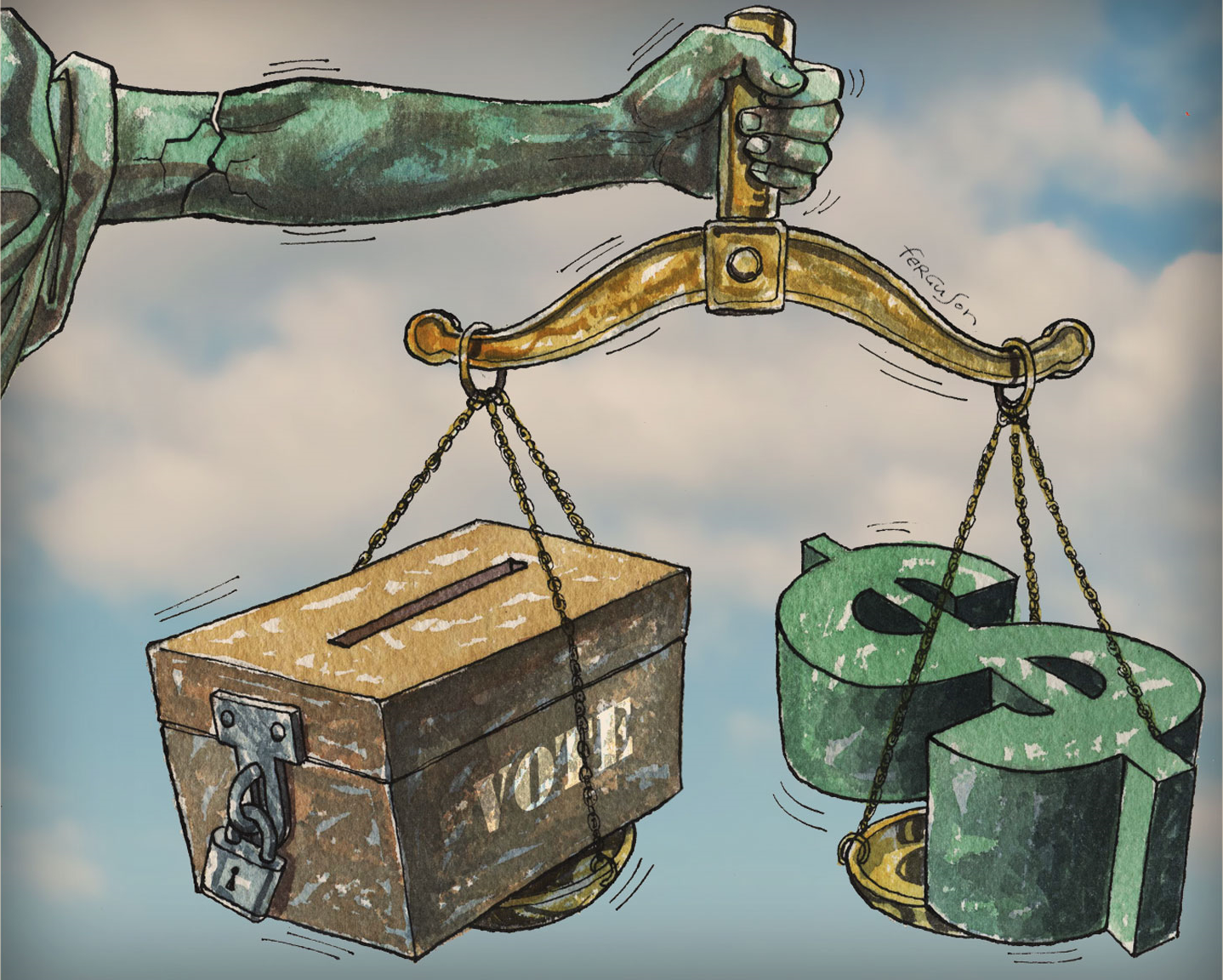
Capitalism and democracy. [11]

Modern Capitalism

Capitalism survives in various political environments around the globe, and its success is not solely attributable to its intimate association with liberal democratic systems. From both a theoretical and a practical perspective, capitalism is more compatible with liberal democracy than any other political system, but that compatibility is not exclusive. [2]

Capitalism is just an economic system, but it still has some influence over politics. Critics of capitalism and liberal democracy often treat them as together or the same, but they could not be further from the truth, as there are clear boundaries that separate them. One of them is a economic system, and the other is a political system. However, most countries that are capitalist are also democratic in some way. Also, many capitalist countries have some socialist ideals, such as social security and minimum wages. This is a common trend found with any economic system. Most of the time, a pure form of that system is not implemented. An economic system and beneficial ideals of other economic systems are merged together to create a more diverse system that attempts to benefit everybody.

Theories Over Time

... the lives of precapitalist peoples were probably more satisfactory on the whole than the lives of the mass of unprivileged people living in modern capitalist states. [2]

During the Enlightenment

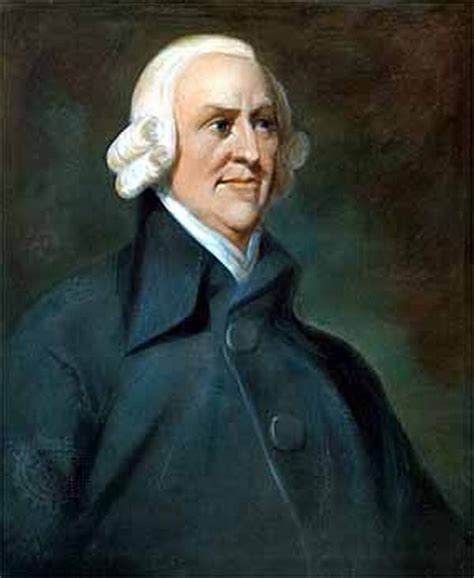
The Enlightenment was a period of time in Europe which took place in the 17th and 18th centuries. Along with other philosophical ideas, Capitalism was an economic system that was introduced to the world, which was mostly Adam Smith's and David Ricardo's ideas at the time. However, many economists at the time also believed that "backwards countries" needed to be colonialized because they did not have much economic growth. Peoples belonging to these "backwards countries" were characterized as "lazy" and "ignorant". This gave industrialized European countries a reason, a weak one, to go ahead and colonize countries. John Stuart Mill saw that India, colonized by Britain at the time, had oppresive institutions formed by the British, which demotivated the people and decreased efficiency.

Illustration of Adam Smith. [14]

Creative Destruction

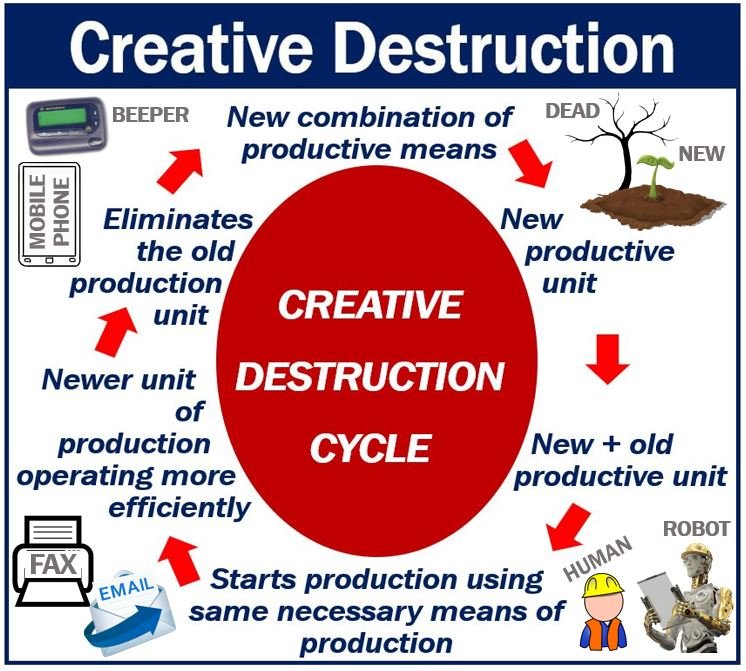
Joseph Schumpeter was an Austrian economist who lived from 1883 to 1950. He is most known for the concept of "creative desctruction." To put it simply, a capitalistic system always evolves over time with new markets and new products. For example, in the 1800s, many were looking for improvements to horse buggy transportation, and horses had a very high demand. In 1908, this would be put to a halt, as Ford comes up with the Model T, which was superior to horses in almost every way imaginable. Do you see people today actively trying to buy horses for travel purposes? The answer is most likely "No". This is an example of Schumpeter's creative destruction. Businesses innovate to create something superior to what is currently in the market, and the superior invention goes on to thrive until something else takes its place. And the inferior product is left in the dust.

Creative Destruction is a never ending cycle. [15]

What's the Problem?

On the economic front, capitalism is a commodity production system. That's the engine that keeps things running. Making stuff for the sole purpose of selling it for more than it costs to make. Profit-motivated production.

Competition

In the concept of creative destruction, a new and innovating product takes the throne, leaving the old product to rot. This creates competition, because companies and businesses actively seek out ways to improve their product, as well as researching new products that will catch a consumer's eye. This creates competition, because businesses must improve and innovate in order to stay alive. Otherwise, they will be left in the dust. But what are they competing for?

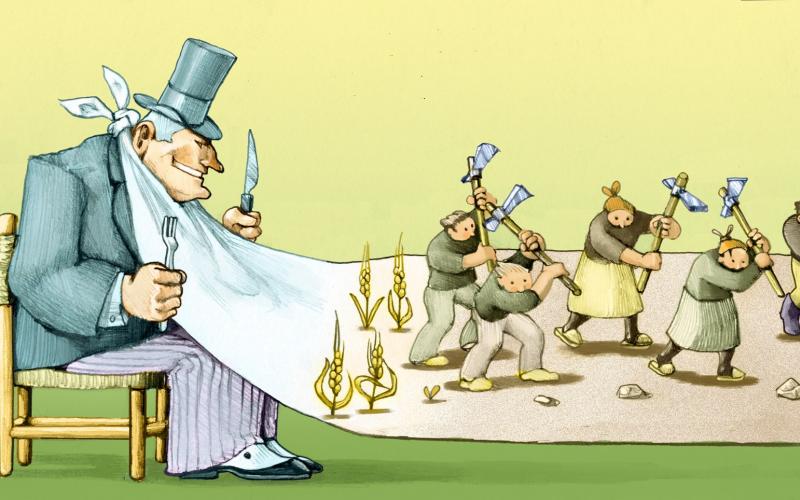
Feeding off of workers [16]

Profit

Profit is what they are competing for. Most of the profit goes to the orchestrators of the company, which are a select few individuals. Then the majority of the company are hard-working individuals who spend multiple hours a day contributing their labor to the company. Remember how only 26 people in 2019 had as much wealth as half of the world? Does that sound familiar to the structure of a company?

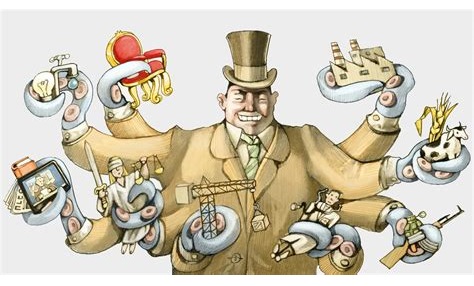
Capitalism is a hegemonic social order. Capital seeks to dominate as many aspects of our lives as possible and to control every institution, from state to schools. Very little escapes its dom­ination, including our thoughts. Its two essential underpinnings are exploitation of wage labour and the expropriation of nature, the non-market labour of women, and the bodies of black and other minority people. A complex set of structures supports these. Is it possible for capital’s chief antagonist, the working class, to combat and defeat it? [8]

The Math Behind Inequality

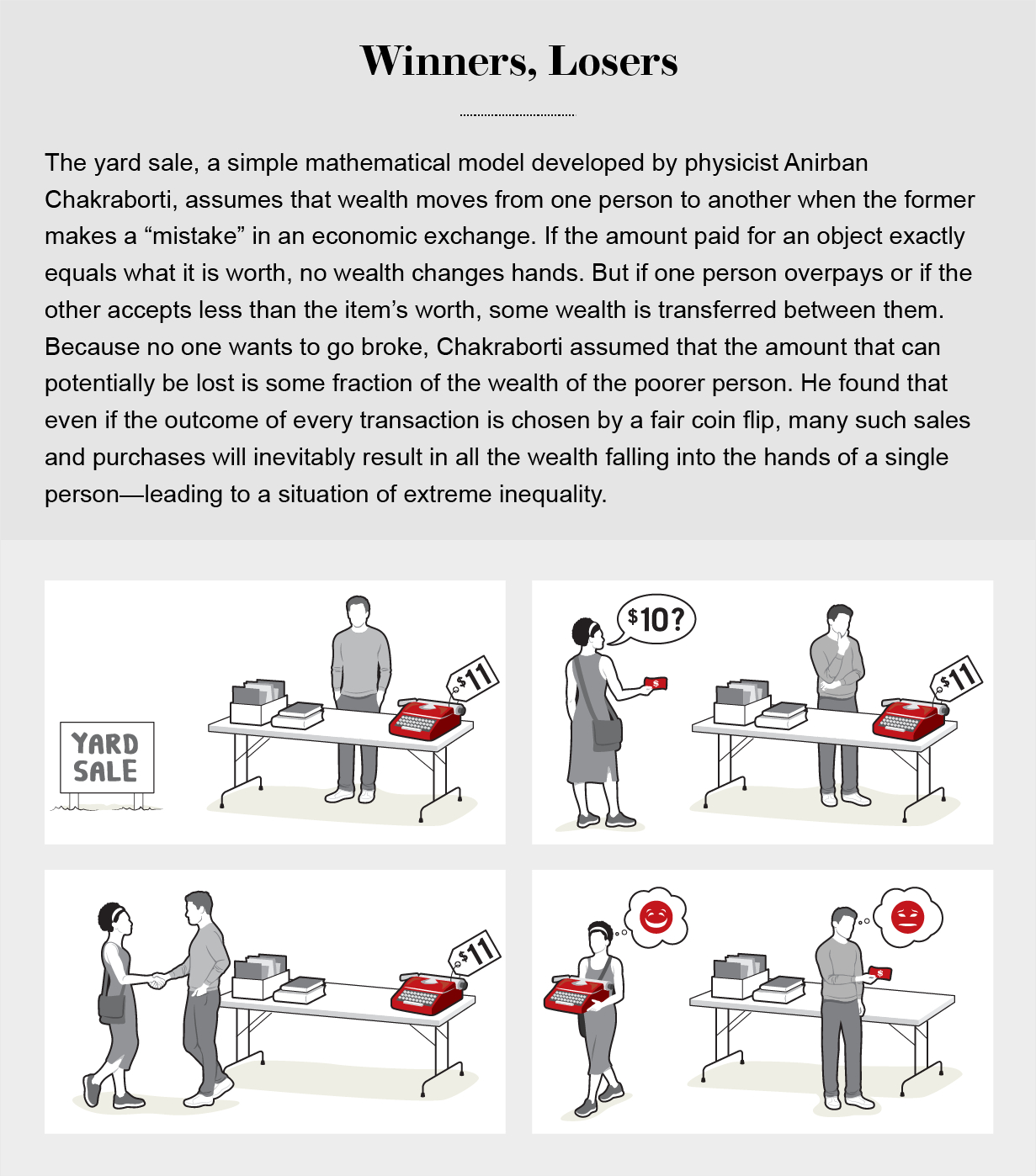
[17]

The yard sale model above, initially introduced by Anirban Chakraborti, demonstrates, through mathematical means, how wealth inequality can be created. And the result is not a slight shift in wealth, rather, an oligarchy. Why does this happen? Here is Professor Bruce M. Boghosian's similar example.

To understand how this happens, suppose you are in a casino and are invited to play a game. You must place some ante—say, $100—on a table, and a fair coin will be flipped. If the coin comes up heads, the house will pay you 20 percent of what you have on the table, resulting in $120 on the table. If the coin comes up tails, the house will take 17 percent of what you have on the table, resulting in $83 left on the table. You can keep your money on the table for as many flips of the coin as you would like (without ever adding to or subtracting from it). Each time you play, you will win 20 percent of what is on the table if the coin comes up heads, and you will lose 17 percent of it if the coin comes up tails. Should you agree to play this game? [4]

The answer is no, you should not accept the game. Let's say in 10 flips, you get 5 heads and 5 tails. If you calculate your earnings, you will find out you will get back 98.02% of your total. This is a 1.98% loss, so it may sound like you win more based on percentages, but in reality, you lose more. If we go back to the yard sale model, any slight wealth transfer is still a wealth transfer, and in the end, a single oligarch will be left standing with most of the money. The same outcome will be reached even if each individual has an equal amount of money.

The World Today

... you can accurately predict a baby's future salary using only the ZIP code they're born in, their race, and their gender. [6]

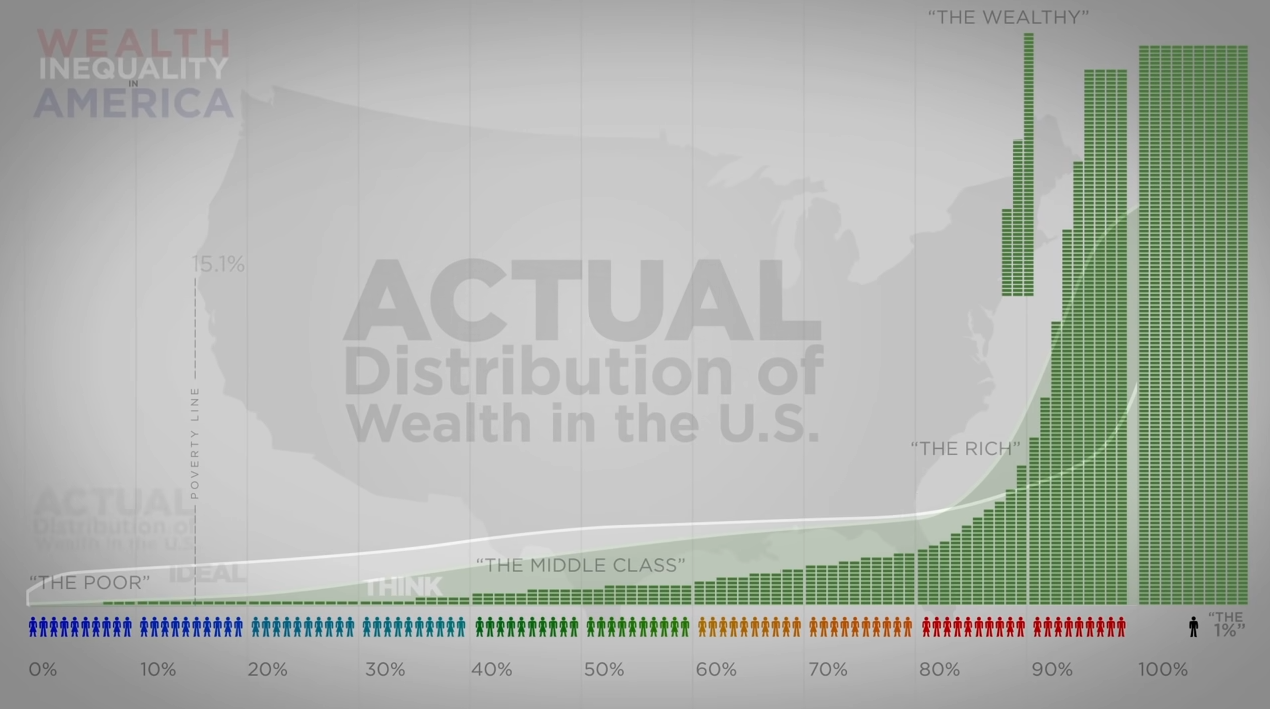
Chart of Wealth Distribution in America [8]

The chart provided above accurately displays the wealth inequality in America during 2012, along with what 5,000 Americans think the wealth distribution is, and what those 5,000 individuals thought the ideal distribution is. What the Americans think is real, and what they think is ideal, don't come close to what reality is. The top 1% of people have 40% of the country's GDP, and the bottom 50% have only 7% of the country's GDP.

Solutions

There are a plethora of solutions that will mitigate or remove wealth inequality. First, we could transform into a fully socialist government. Surveys indicate that a majority of Americans despise socialism, so that is not an option for the US, but could be for other countries. Another incredibly successful idea is to implement socialist ideals. America already has many, like social security, but we clearly don't have enough. However, unlike socialism, which has not been used successfully, the Nordic countries have followed many socialist principles, and it is estimated that countries like Denmark have such little inequality that Denmark ranked third in the world with the most equality, only behind Iceland and Norway. We could try other approaches, but the important detail remains clear. We identified a brick wall in the path to making the world equal.

Works Cited

[1]. Bragg, Melvyn, host. "Capitalism." In Our Time, BBC, 24 June 1999. BBC Radio 4 - In Our Time, BBC, www.bbc.co.uk/programmes/p00545kv. Accessed 28 Feb. 2023.

[2]. Han, Lori Cox, and Tomislav Han. "Capitalism and the American Political System." Handbook to American Democracy: Foundations of American Democracy, Facts On File, 2012. American History, online.infobase.com/Auth/Index?aid=129928&itemid=WE52&articleId=357379. Accessed 1 Mar. 2023.

[3]. Reill, Peter Hanns, and Ellen Judy Wilson. "Capitalism during the Enlightenment." Encyclopedia of the Enlightenment, Revised Edition, Facts On File, 2004. Modern World History, online.infobase.com/Auth/Index?aid=129928&itemid=WE53&articleId=269815. Accessed 1 Mar. 2023.

[4]. Boghosian, Bruce M. "Is Inequality Inevitable?" Scientific American, Springer Nature, 1 Nov. 2019, www.scientificamerican.com/article/is-inequality-inevitable/. Accessed 4 June 2023.

[5]. "Socialism." Issues & Controversies, Infobase, 19 Jan. 2021, icof.infobase.com/articles/QXJ0aWNsZVRleHQ6MTY0OTU=. Accessed 4 June 2023.

[6]. "How Capitalism Causes Loneliness." YouTube, uploaded by JT Chapman, 2 June 2023, www.youtube.com/watch?v=BwQCnltp9lo. Accessed 4 June 2023.

[7]. Adler, David. "Schumpeter's Theory of Creative Destruction." Carnegie Mellon University IRLE, David Adler, 30 Sept. 2019, www.cmu.edu/epp/irle/irle-blog-pages/schumpeters-theory-of-creative-destruction.html. Accessed 4 June 2023.

[8]. Chowdhury, Farooque. "Expropriation and capital's development." Pambazuka News, 17 Jan. 2019, www.pambazuka.org/arts-books/expropriation-and-capital%E2%80%99s-development. Accessed 4 June 2023.

[9]. "Wealth Inequality in America." YouTube, uploaded by Politizane, www.youtube.com/watch?v=QPKKQnijnsM.

[10]. "Why Is Denmark So Rich Despite Huge Taxes?" YouTube, uploaded by VisualEconomik EN, 9 Jan. 2023, www.youtube.com/watch?v=fE8flS-vXxE. Accessed 4 June 2023.

Images

[11]. "Capitalism and Democracy." Financial Times, www.ft.com/content/e46e8c00-6b72-11e6-ae5b-a7cc5dd5a28c. Accessed 4 June 2023.

[12]. "Capitalist Controls Everything." UChicago News, 10 Jan. 2020, news.uchicago.edu/story/does-capitalism-need-protection-big-business-uchicago-economist-says-yes. Accessed 4 June 2023.

[13]. "Inequality between Top 1% and Bottom 99%." World Atlas, 3 June 2020, www.worldatlas.com/articles/what-s-the-alternative-to-capitalism.html. Accessed 4 June 2023.

[14]. "Illustration of Adam Smith." The Globe and Mail, 16 June 2015, www.theglobeandmail.com/report-on-business/rob-commentary/economist-adam-smiths-greatest-legacy-is-his-balanced-approach/article24963305/. Accessed 4 June 2023.

[15]. "Schumpeter’s Creative Destruction Cycle." CDES, cdes.es/blog/que-es-la-destruccion-creativa-definicion-y-ejemplos/. Accessed 4 June 2023.

[16]. "Capitalist Feeding off of Workers." Pambazuka News, 17 Jan. 2019, www.pambazuka.org/arts-books/expropriation-and-capital%E2%80%99s-development. Accessed 4 June 2023.

[17]. "Winners, Losers in Yard Sale Model." Scientific American, 1 Nov. 2019, www.scientificamerican.com/article/is-inequality-inevitable. Accessed 4 June 2023.